
Cool Facts About the WA Starter Home Plan
-
n 2024, the Washington State Legislature approved the use of public funds for the development of a comprehensive and actionable multi-year strategy and plan for scaling statewide production of affordable starter homes. The strategy and plan were required to be capable of leveraging innovative offsite and prefabricated methodologies, creating sustainable economies of scale, and overcoming existing operational barriers. The RFP process and funding were administered by the Washington State Housing Finance Commission (WSHFC), who awarded the contract for plan development to Civic Commons. In September 2024, Civic Commons convened an expert multisector project team and collaborator network who delivered the Comprehensive and Scalable Starter Home Production Plan, the Ecosystem Playbook, and the Demonstration Playbook to WSHFC in July 2025.
-
The Starter Home Plan’s transformational potential hinges on ownership throughout the state’s housing ecosystem. Civic Commons’ recognized expertise in network weaving enabled them to convene and facilitate a diverse constellation of expert collaborators who co-created the Plan and Playbooks. That convening and facilitation is now critical to building a network of multisector players from throughout the state’s housing ecosystem who understand that the Plan is a permanent, broadly shared, comprehensive strategy and not a program or project of a single organization.
-
1. Combine strong demand, broad public support, lower development risk, and the production volumes needed to drive innovation, financing, workforce development, and long-term scale. This makes starter homes uniquely capable of building production muscle throughout the housing ecosystem.
2. Provide a common-sense entry point through which all of the sectors and industries affecting housing supply— communities, developers, manufacturers, lenders, workforce partners, and public agencies— can build the capacity, confidence, and coordination needed to achieve and sustain scaled delivery.
3. Offer an ideal proving ground for transformative production models (such as the comprehensive roadmap used by SHP). Smaller footprints and lower capital requirements make starter homes well suited for testing assumptions and refining new methods before expanding into larger and more complex housing opportunities.
-
Not directly. Governor Ferguson has set up a special task force charged with developing recommendations for a new cabinet-level housing agency focused on expanding housing supply, better aligning state housing programs, and addressing housing needs across Washington state. The Starter Home Plan and Playbooks are an integral part of what this new Department of Housing would be supporting if it is funded and launched in 2027-2028. Ultimately, it is envisioned that the WA Department of Housing would be responsible for the work.
In the meantime, Civic Commons has taken on the role of facilitating formation of the Plan’s Project Management Collaborative and convening the broader implementation network.
-
The Plan’s statewide survey found that 47.1% of first-time homebuyers surveyed preferred a 1,000sf home with two bedrooms, and 33.3% preferred a 1,200sf home with three bedrooms. Only 11.8% wanted a home of 1,400+sf. These buyers ranked durability, efficient HVAC, single-story living, a backyard, and walkability as more important than home size. This trend is consistent with recent national data from Zillow, Harvard, and the Bipartisan Policy Center and with sales data from factories and modular developers in Idaho, the rural Midwest and Mountain West, and British Columbia, Canada. Builders have stopped making smaller, more affordable homes because larger homes produce higher margins. When modestsized homes do reach the market, they sell rapidly. The “starter home” size band (800–1,400sf) is where demand is highest among first-time buyers in Washington state. Additionally, modern modular and offsite constructed homes show no inherent resale penalty compared to site-built homes, and in many markets, they appreciate at the same rate or even faster.
-
Builder/developers can make a profit on starter homes, but only if the ecosystem removes today’s structural barriers: land costs, permitting delays, financing misalignment, lack of standardization, and unpredictable demand. The Starter Home Plan and Playbooks show exactly how to change those conditions so that builders and developers prefer producing starter homes, because it becomes faster, less risky, more predictable, and still profitable, making starter homes a source of recurring, repeatable, predictable revenue.
-
This question hits the nail on the head! “Technical challenges” are definitely a big part of the problem. They’re the things that can usually be solved with specific expertise or authority, and the Starter Home Plan and Playbooks address these in detail. But the crisis is also perpetuated by a lot of “adaptive challenges” that can’t be solved by expertise or an improved technology. These include common expectations and behaviors of developers, buyers, funders, financiers, policymakers, and industry competitors. For example, a buyer’s expectations for home size and amenities can be at odds with what they can afford. One reason that purely technical approaches haven’t eliminated the shortage of for-sale starter homes is that they don’t respond to the entrenched adaptive challenges standing in the way.
-
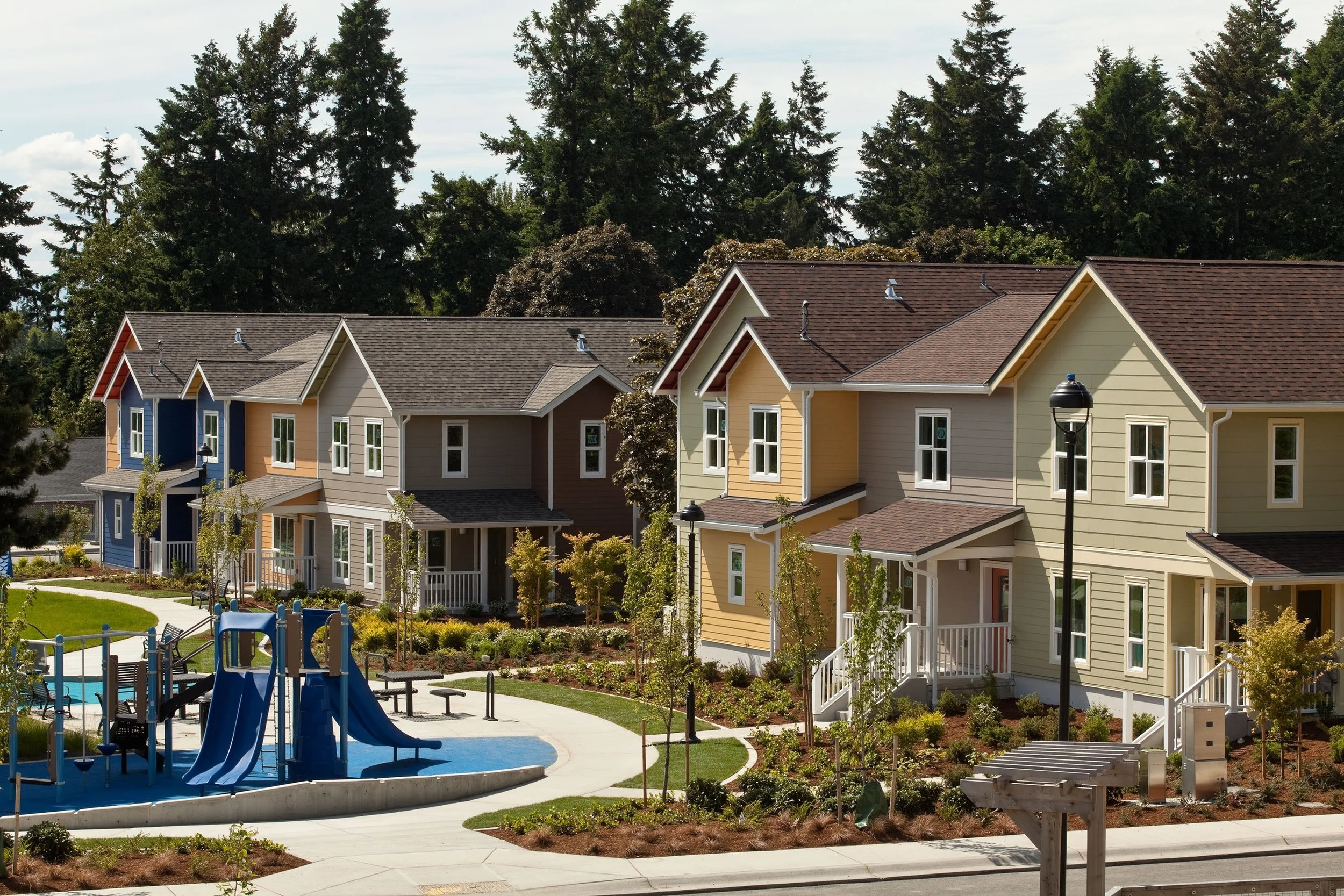
The Starter Home Plan recognizes that many factors may spur community resistance, including stigma, misunderstandings, cultural expectations, and concerns about property values, neighborhood character, and identity. The Plan clearly articulates these adaptive challenges and recommends coordinated messaging and public education, including features on the demonstration projects, to provide facts and concrete examples illustrating what high quality, small, attainable homes really look like.
-
This is a question we love to get. So thanks for asking it! We also love our answer, which is here.
-
Offsite construction can reduce construction costs, and the Starter Home Plan is designed to unlock those savings. Today, cost savings are limited due to regulatory friction, inconsistent demand, and financing misalignment. With the Plan fully implemented, offsite construction becomes faster, cheaper, more predictable, and more scalable, with total development costs going down as standardization and volume take effect.
Bottom line: offsite construction gets cheaper when the whole system is redesigned to support it, and that calls for the comprehensive, systemic roadmap provided by the Starter Home Plan.
-
The Starter Home Plan identifies several regulatory barriers that must change, including inconsistent local permitting, dual state/local inspection authority, lack of standards for modular and offsite, restrictive zoning, absence of by right approvals, slow infrastructure reviews, and unpredictable fees. Many jurisdictions have acknowledged the issues, but statewide change requires state level leadership because not all jurisdictions can streamline and adapt without support and encouragement.
-
Past modular attempts failed because the system around them never changed. The Starter Home Plan changes the entire system. It doesn’t just promote modular construction; it creates the land pipeline, financing model, regulatory framework, workforce strategy, and standardized designs that modular needs in order to work at scale. The Plan is explicit about this, noting that “Offsite construction is not new, but what is new is combining it with the adaptive, cultural, regulatory, and ecosystem changes needed to support it. Without these changes, past efforts were ‘destined to failure before they start.’”
-
Appropriate production targets and timelines will be determined from data collected during Plan implementation, and are two of its key outputs.
-
The Demonstration Program is designed to rigorously test the Plays and the hypotheses they embody. A successful demonstration project will likely reveal both areas of expected performance and departures from it. Departures are extremely important sources of information, because they point out where assumptions (or their implementations) were faulty, under what conditions, and how to adjust, allowing the iterative refinement and reassessment necessary to validate the model. The data to be captured, and the measurement and verification processes, are described in specific detail in the Demonstration Program Playbook.
-
Absolutely. The Plan’s success depends on active engagement of private-sector lenders and developers. Because their participation is critical to building and financing production of affordable for-sale houses, it is explicitly architected into the Plan and Playbooks and represents one of the Plan’s four fundamental recommendation categories.
-
To the degree feasible, the Starter Home Plan encourages the use of designs that excel at, and are adaptable to, each of these. Naturally, homes produced in accordance with Plan-recommended methods will meet or exceed existing state requirements for sustainability.
-
The Plan creates an exciting opportunity. Implementation of the Plan and Playbooks, solely focused on for-sale homes, can be leveraged to pave the way for future expansion of offsite methods in other types of housing (e.g., multi-family rental and permanent supportive housing).
-
The Starter Home Plan is not a program that builds or sell homes. It is a plan available to builders and developers, who can use it to create and sell quality, affordable for-sale homes. Any WA resident dreaming of purchasing a home, but unsure how to go about it, should begin by visiting Washington Homeownership Resource Center.
-
No. The Starter Home Plan is intentionally focused on delivering solutions that accelerate and scale starter-home production throughout Washington state, taking into consideration differences in housing typology across communities.
-
There are lots of terms, and it can be confusing. Offsite construction is a method in which building components (such as wall panels or full volumetric modules) are manufactured in a factory and then transported to the site for assembly. To compare the differences between terms like “offsite construction,” “manufactured home,” “modular home,” and “industrialized housing,” just go to the Glossary section of the Starter Home Plan.
-
One of the Starter Home Plan’s four subnetworks is focused on Financing, and one of their goals is to design and scale capital strategies tailored to offsite methods and Missing Middle homeownership. “Missing Middle” commonly refers to a range of housing types (such as duplexes, fourplexes, cottage courts, and courtyard buildings) in walkable neighborhoods. Read more about Missing Middle Housing here.
-
Washington state does not lack land; it lacks a coordinated system to identify, prepare, and allocate land for starter home development. This is the reason for land clearinghouses set up regionally. Starter home land supply will come from underutilized public land (city, county, state, transit, utilities); land owned by faith-based organizations; institutional land; privately owned land suitable for infill or redevelopment; regional land clearinghouses that identify, bank, and prepare land; newly available sites unlocked by statewide zoning reforms; and parcels made feasible through standardized permitting and offsite construction rules.
-
The Starter Home Plan does not dictate where builders must get their building materials. Instead, it focuses on creating the ecosystem, standards, and processes that make starter home production faster, cheaper, and more predictable, leaving material sourcing decisions entirely up to builders and manufacturers. The Plan speaks about materials that are durable, low maintenance, energy efficient, and compatible with offsite production. These are performance expectations, not sourcing mandates. The Plan calls for fostering a supportive supply chain and vendor network, which will naturally include mass timber providers, CLT manufacturers, modular/panelized component producers, and traditional material suppliers, but builders will not be required to use any particular supplier.
-
The Starter Home Plan seeks to speed things up by standardizing designs, standardizing rules, and removing red tape, so builders can get permits faster, easier, and with far less uncertainty. The Policy and Regulation subnetwork will emphasize the use of preapproved building designs, creation of one consistent permitting system statewide, and fixing the confusion between state inspectors and local inspectors. The Land and Development Subnetwork will help by preparing “project ready” land in advance. Regional land clearinghouses will identify sites and solve many issues before a builder ever applies for a permit.
-
The Starter Home Plan’s Workforce subnetwork will drive a holistic strategy to create the necessary workforce. It emphasizes retraining of existing construction trades for modular/offsite roles; preparing new workers statewide via community and technical colleges; attracting new industry entrants who seek safe, stable, year-round factory based work; and engaging small, emerging businesses (including firms owned by women and people of color) in the starter home ecosystem.
-
We’re committed to helping your group become engaged in ways that inspire you and serve your priorities. To explore possibilities, please use this site’s contact form.